

Gold only beats inflation. It fares poorly when compared to real estate or shares when compared on the basis of real inflation adjusted returns. Any serious investor, however, is advised to have a certain percentage of investment in gold to hedge inflation.
Investors, speculators, hedgers and consumers who sold their gold stocks to partly set off losses in the financial markets will start replenishing within six to eight months, says Ajay Mitra, managing director - Indian sub-continent, World Gold Council.
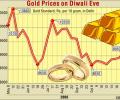
After yellow and white, pink gold is set to hit Indian jewellery retail stores by the end of this year.

The proposed bullion bank can help settle gold loan accounts in gold terms, and promote existing gold schemes, along with launching schemes including gold-recurring deposits.
With their increasing economic independence and rising personal wealth, more and more women in India are preferring to buy gold, World Gold Council has said.
Rising bullion prices was no deterrent to the Indian gold jewellery segment in India as sales soared in the third quarter of the current fiscal (Q3).
Gold prices on Friday rose by Rs 210 to hit another five-week high of Rs 28,300 per 10 grams in the national capital on sustained buying by stockists amid a firming global trend.
The World Gold Council has suggested that banks be allowed to offer gold-backed saving products to channelise gold investments in the banking sector.
The only element of demand for gold likely to be affected by a recession is investment demand, "but that in turn will depend on the 'type' of recession,". Recessions can be bad for commodity prices, as consumer and business confidence falls, demand for goods and services is cut, weighing on demand for raw materials and depressing prices.
While gold consumption is expected to stabilise this year, it may be some time before it revisits record levels seen in the depths of the financial crisis.

Indian central bank may soon edge out its counterpart in the Netherlands from the top-10 list, as latter's holding has largely remained unchanged.
Gold demand fell by 8 per cent to 45 tonnes on this year's Akshaya Tritiya, an auspicious day in the Hindu calendar for new purchase of long-term assets, due to a rise in prices, compared with 48.9 tonnes in a year-ago period, the World Gold Council said.
Gold is back in favour with consumers shifting their focus on the precious metal on the back of moderation in prices.
A gold-encrusted dagger once carried by the builder of the Taj Mahal is expected to fetch some 500,000 Euros at an auction this week, says a report from the World Gold Council web site. The artefact, which was once held by the Mughal Emperor Shah Jahan, is being auctioned at Bonhams on Thursday. The gold-encrusted dagger is part of the collection of Indian and Islamic art & artefacts owned by Jacques Desenfans, who spent more than 50yrs collecting historical & cultural items.
Gold prices hit record high in the third week of March as fears of bank collapses and high inflation led investors to the traditional safe haven. Gold prices are often inversely correlated to dollar strength because the international price is dollar-denominated. The Federal Reserve's (Fed's) stance indicates that the dollar may appreciate further since it is prepared to keep pushing up policy rates. But demand for gold is also up - the World Gold Council claims central banks are buying in addition to private demand.
According to industry estimates, 5 per cent of India's total gold consumption of about 750 tonnes is sold on this auspicious day alone. This year, too, customer's attraction towards gold is likely to continue despite high prices.

Junior Civil Aviation Minister G M Siddeshwara told Parliament that disciplinary action has been taken against the employees.

'There are very few issues and a political call needs to be taken about some of them.'

Consumers during the quarter sold 37.9 tonnes of old gold, which is the highest quarterly sale after September 2016, when old gold sale, or scrap supply, was 39 tonnes.
The demand for gold is expected to take a hit if the price of the yellow metal - which has been hovering around Rs 60,000, a level never seen before - remains elevated. Due to a sharp increase in price in a very short time and the flow of smuggled gold continuing, gold price in Mumbai is quoted at around Rs 59,000 per 10 gram. Typically, overall demand in the January-March and July-September quarters is moderate-to-dull, which is the case in the ongoing period.
The government has hiked gold import duty to 15 per cent from 10.75 per cent to check the current account deficit (CAD) and rising import of the yellow metal. The duty changes came into effect on June 30. Earlier, the basic customs duty on gold was 7.5 per cent, now it will be 12.5 per cent.
In comparison to other asset classes, globally, gold rallied significantly after many years to deliver 18.4 per cent returns in 2019.
A yellow glow is likely to stand out amid grey geopolitical clouds in 2023, with gold price projected to touch Rs 60,000 per 10 grams in the Indian market as more investors veer towards safe-haven assets. In a year where volatility was more a norm than an exception, gold prices in the international market oscillated from a peak of $2,070 per ounce in March to a low of $1,616 per ounce in November and is steadily recovering since then, according to market experts. At the beginning of 2022, gold prices were around $1,800 an ounce.

A WGC survey says that there is no dearth of gold demand, but there is lack of trust among prospective gold buyers, not only in India but globally.
Price up on weak dollar and strong demand

The Gems and Jewellery Export Promotion Council (GJEPC) has urged the Centre to provide immediate relief measures as the tariffs imposed by the United States have started hitting the industry. US tariffs of 50 per cent on Indian goods came into effect on August 27.

'India has about 22,000 tonnes of private gold, held by individuals and temples.' 'Much of this is locked up in safes and vaults as a dead investment. If we can put the vast reserves of gold to use, it would boost the economy,' says V P Nandakumar, executive chairman, Manappuram Finance, India's first listed gold loan company.
Consumption of gold is the highest among middle-income households - those with annual income between Rs 2 lakh and Rs 10 lakh - who account for an average of 56 per cent of gold sales over the last five years, according to a nationwide survey conducted by India Gold Policy Centre (IGPC) at the Indian Institute of Management, Ahmedabad (IIM-A). "Per capita consumption is highest among the rich, but total volume still rests with the middle-income group. "With increasing income, there is an increasing propensity to consume gold, although the share of gold in the portfolio does not increase with the same proportion of income," the survey report says.

Gold import this financial year is estimated at 945 tonnes.
Mandatory hallmarking of gold would be a positive in making the gold market more organised. Mandatory hallmarking would come into effect from January 15, 2020, with a one-year transition period for trade to sell existing inventories. Experts also expect more policy measures next year to bring in more transparency in terms of gold as an asset class.
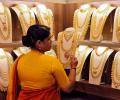
Dhanteras has cheered up jewellers as it has turned out to be the best in three years, thanks to the lower price of the yellow metal and pent-up demand. In Mumbai's Zaveri bazaar, buyers came in out force and jewellers did not have to depend on freebies to induce sales, even though all of them had announced some offers. In fact, more discounts were announced for diamond and studded jewellery.
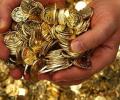
Spot gold was substantially higher at USD 1,117.40 an ounce in early European trade.

The first-ever Khelo India Water Sports Festival is all set to reveal the iconic Dal Lake in a new avatar.

The government on Friday hiked import tariff value on gold to $401 per 10 grams and on silver to $543 per kg in line with global price trends.

With Indian jewellery market already on the robust recovery path, the jewellers are expecting strong Diwali sales in the Dhanteras as the festive mood remains high with low Covid third wave possibility and softer gold price this season. The industry expects the trends in 2021 will be able to reach pre-covid level sales of 2019 on the back of gold price hovering at Rs 46,000-47,000 per 22 carat 10 grams gold nearly 5 per cent lower than 2020, and jump in number of weddings, a senior official of an industry body said. "Since Navratri market is showing demand. It will continue on Dhanteras also.

However, in 2020, gold demand in India -- the world's second biggest consumer after China -- could increase to 700-800 tonnes on hopes of increased acceptance of high price level and likely economic reforms boosting consumer confidence, World Gold Council said.

The demand for gold has bounced back sharply in India from the lows seen in 2020 because of the outbreak of the Covid-19 pandemic, and has even beaten the pre-pandemic level. In the September quarter, the demand for gold jumped 47 per cent year-on-year (YoY) to 139.1 tonnes, as against 94.6 tonnes in the year-ago period, and higher than the 123.9 tonnes recorded in the pre-pandemic September 2019 quarter, the World Gold Council (WGC) said in its latest release. In value terms, demand surged 37 per cent year-on-year (YoY) to Rs 59,330 crore during the quarter.

It was an invite-only event that blended delectable cuisine, curated cocktails and a stunning showcase of craftsmanship.
